
Behind the Japan Exhibits
“People often ask, “How does someone like you with marginal social skills and barely functional manners—end up working with the Japanese?” A culture famous for its grace, refinement, and etiquette, where even something as small as a grain of rice left in your bowl carries meaning. Attention to detail is important even with gifts which must be wrapped in the appropriate color paper for the occasion.
It’s a fair question.
The Japanese are masters of line work. Calligraphy for example isn’t just writing but an art form, a meditation, a discipline. It’s a way to tell a story with the fewest possible marks, to capture emotion and essence without excess. That idea, capturing something directly, and without overstating has always appealed to me. Maybe I’m flattering myself here, but I like to think some of my drawings, especially my black line work, tap into that same spirit. Maybe that’s what the Japanese saw in it. Just a theory.
Anyway, back in the ’80s, I did something every art business book will tell you never to do: I cold-walked into a gallery. Not just any gallery, mind you—a Japanese-owned gallery on the Upper East Side of Manhattan. Tamenaga Gallery, right across from the Carlyle Hotel.
I had a slide sheet of my work—this was before digital portfolios—and my eight-year-old nephew tagging along. He promptly began running laps around the gallery, turning the place into his own personal racetrack, while I stood there trying to present my work to a very uptight man behind the desk. The guy looked like he had a pole jammed up his ass. Still, to his credit, he politely flipped through the slides.
“Leave your number,” he said.
“Sure,” I said, thinking, Yeah, you’ll call.
We left and went next door to grab burgers at Three Guys. I figured that was the end of it.
But three months later, in the middle of a brutal summer heatwave, a limousine pulled up in front of my third-floor walk-up in Long Island City. Four immaculately dressed Japanese gentlemen stepped out. I was scrambling around the apartment, trying to hide liquor bottles, cereal boxes, and assorted junk.
They barely noticed. They came in, looked around, and asked for a painting of two cops leaning on a police car in the middle of New York City. I handed it to them. They bought it on the spot. It sold in 15 minutes.
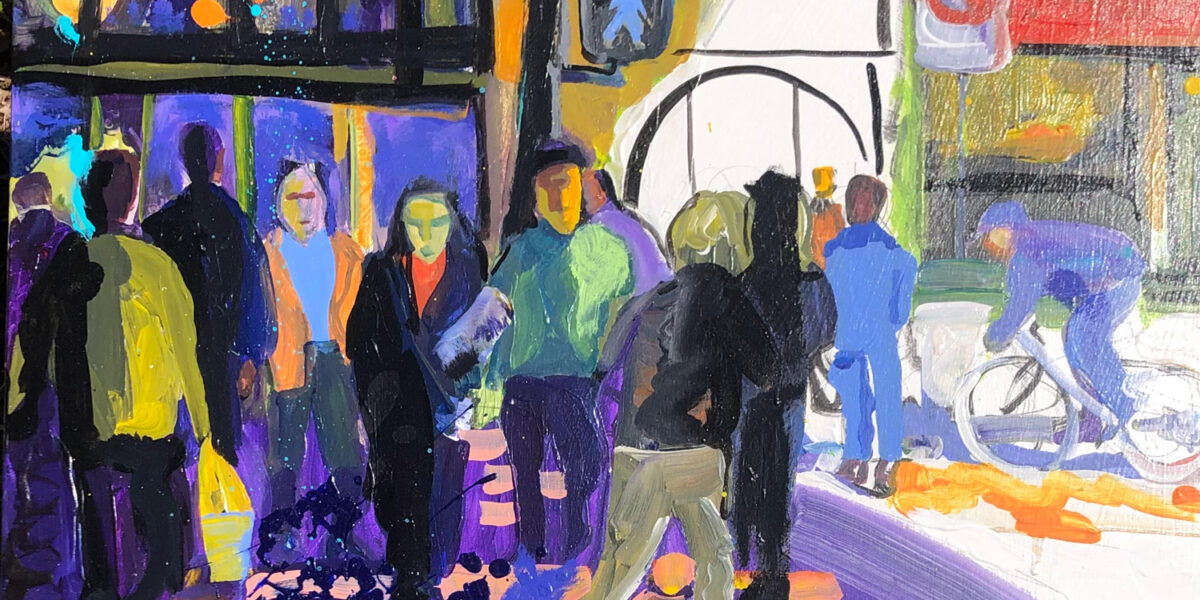
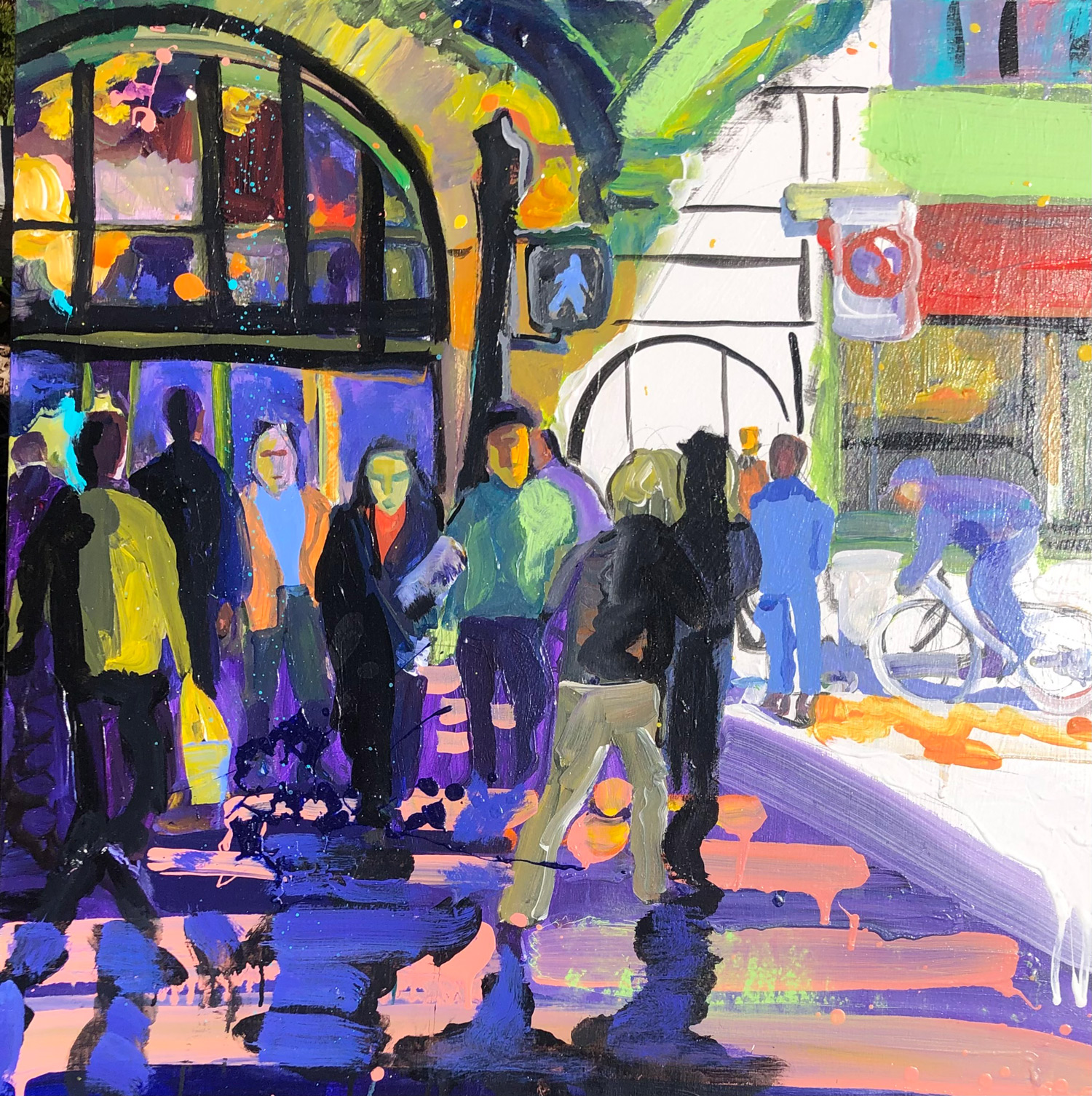
“Let’s try another one,” they said. So we did. That one sold too. Then came a show. And, well… the rest is history. I’ve been painting New York City for the Japanese ever since—more than 25 years now.
What do they see in the work? They see white space. They see calligraphic lines. They see color. They see classical drawing skills. They see a story—a visual narrative. And maybe, despite the manners, that’s enough.
Eventually, the gallery flew me to Osaka for a solo show. While I was there, they took me straight from the airport—jet-lagged, sleep-deprived, disoriented—to see a living master of Kabuki theater. This guy wasn’t just good. He was the guy. The only one in 300 years to master every element: the voice, the movements, even playing guitar.
They sat me in the third row, center. Everyone in the audience was maybe 5’5”. I’m not. I stood out like some kind of lumbering, jet-lagged Gulliver in an ill-fitting suit.
The curtain opened. Discordant music began: clack clack clack clack—bing bong bing bong. The lead actor entered to thunderous applause. And me? I was fighting to stay awake. My head kept dropping forward, landing face-down on my tie. I was spiraling.
Then I remembered—Jolly Ranchers. I had two in my pocket. Green apple. I popped one in. A sugar rush jolted me awake for about 30 seconds. Two hours later, I came to. Chin resting on my necktie. A hardened green sugar stalagmite had formed, stretching from my lower lip down to my lapel. I snapped my head up. The sugar spike snapped too. Two hundred heads simultaneously turned away, pretending they hadn’t just been watching this tragicomic spectacle of the “honored American guest” slowly melting into his own tie.
Somehow, they forgave me. After the show, I got to go backstage and shake hands with the Kabuki master himself. Still working on manners.